


[I’m returning from a much-needed vacation this week and pulling some oldies but goodies from the archives so they get a bit more love and attention. This one was originally posted Nov. 4, 2023 when I had a scant 120 subscribers, so it’s time to brush it off again. I’ve made some minor edits to bring it into 2026 in light of changes in my own thinking but the original is still available here. There’s also a follow up post, Landscapes, Binaries, and Scales, where I respond to some of the criticisms of the original, but read this one first!]
I just got back from giving a talk on my 4D framework for radical moderation and the political/social landscape metaphor that I use as the foundation of that work.
Here’s a very brief summary of 5+ years of work:
4D thinking is how we see. It’s epistemic. It’s the practice of looking at a problem along four dimensions instead of one: where you’re standing, who else is in the landscape, what tradeoffs are in play, and how the picture changes over time. It’s the rejection of the one-dimensional, left-versus-right line that most of our political conversation has been flattened onto.
Deep pluralism is what we find when we look. It’s descriptive. Once you actually map a policy landscape in four dimensions, the same fact reveals itself again and again. People with different neurology, different lives, different histories, and different stakes occupy genuinely different points on the landscape. That isn’t a flaw in them or in us. It’s a permanent feature of human life together.
Radical moderation is what we do given what we see. It’s political and moral. It’s the work of building, maintaining, and protecting institutions and citizens that are resilient in the face of deep pluralism instead of brittle in the face of it. Resilient institutions bend without breaking, treat contestation as social learning, and produce outcomes broad enough for actual humans to live with. Resilient citizens connect across partisan lines, hold their convictions without being captured by them, and don’t shatter every time the news cycle does.
In general, talks are a great way to figure out what I don’t understand about my own arguments and what I understand but I’m not communicating well to other people.
One question from the audience that I didn’t answer well was “how is this landscape an alternative to the binary or the more complex frameworks that you’re complaining about?”
I started the presentation with the binary below, arguing that it’s not just empirically wrong, but it’s also morally wrong. It not only doesn’t reflect human political, social, and moral reality, but it leads to morally bad outcomes.
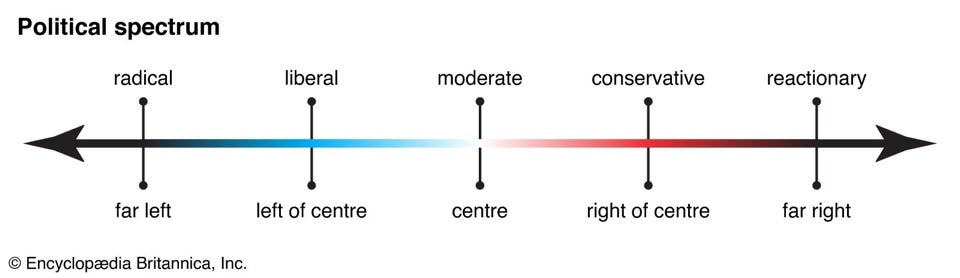
But, one of the audience members asked (or rather, the question implied), “that’s outdated, so what about more complex articulations of the political landscape, like the political compass?”
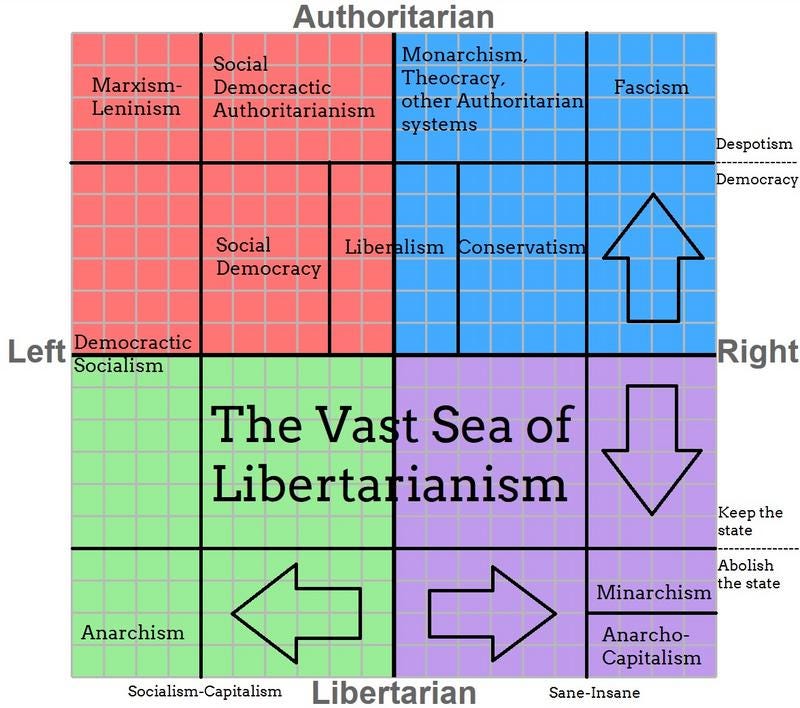
Great question! So what about the political compass above? Isn’t it more complex? Doesn’t it have three dimensions? Isn’t it more accurate? Even more specifically, the question was, “If this isn’t helpful, what’s your alternative? Where do values map onto your landscape?”
This question goes to the heart of the entire project, so I’m glad this person asked. It was clear that he thought I was presenting the complex landscape as a *different* way to locate or organize political beliefs. And that’s exactly what I’m *not* doing.
The radically moderate landscape isn’t an alternative to binaries or compasses at all, but a radical rejection of that way of thinking about politics. And that’s because social, political, and moral values don’t map neatly onto human life the way we think they do. There are no permanent locations of clusters of political ideas because that’s not how humans navigate their shared world. And, I’ll argue, as helpful as these tools are for intellectuals trying to map out the broad landscape of political ideas, they may be actively harmful in practice.
Thank you for reading The Radical Moderate’s Guide to Life. This post is public so feel free to share it.
Are binaries/compasses accurate reflections of real human moral/social/political worlds?
Let’s start with the empirical case.
There is no stable location of any of these political values in the real human social, political, and moral world. We can distort things in order to shove events and people into these categories, but it’s always a distortion because it requires jettisoning so much complexity along the way.
The real social, moral and political landscape looks a lot more like the photo at the top of the page. There are lots of ways to navigate that landscape, lots of decisions that need to be made, and many idiosyncratic values and goals that might animate those decisions. Pluralism runs deep in that landscape.
Moreover, even the most complex of the political paradigms don’t have a fourth dimension, which means that they locate people and human problems at a particular point in time. But social, moral, and political problems morph in really important ways over time.
To be fair, the goal of the political compass isn’t really to think about the entire human social, political and moral landscape. It’s (usually) a way to think about the power of the state or how particular politicians or political thinkers think about the power of the state. And in that very narrow sense, it can be useful. But too often we expand the compass or the binary and stretch it into areas of human social life where it has no real business going.
There are a range of complex human social, moral, and political problems where the compass doesn’t really help us locate anything like solutions. Children and the family, the mentally ill or severely disabled, small local communities, and friendships are all areas where the compass fails to give us much in the way of guidance.
But, someone might reply, that’s only because you’re using it in a way that it’s not meant to be used! Sure, that’s true. But that’s how many people *do* use it. Precisely because the political spectrum or compass is a convenient way to think about the political world it becomes tempting to place oneself on it and once you do that it’s much easier for tribalism to kick in. Once that’s kicked in it’s even more tempting to try to align your beliefs to your particular location on the spectrum, without realizing that you’re distorting yourself in the process.
The political compass is a lot like the body mass index or BMI in that sense. BMI used to be a basic and somewhat helpful screening tool - it was meant as a way to invite someone to ask more questions or do some more digging. But precisely because it was so simple, it very quickly became a diagnostic tool, labeling someone as obese simply based on their height-to-weight ratio. This is obviously very dumb because a simple height-to-weight ratio obscures an enormous amount of important variation, including muscle mass and bone density. That variation is crucial to assessing any person’s actual health status. And that’s very much the case for the political spectrum or compass too. It might be helpful as a first-round screening tool, but when we accept it as a fully accurate depiction of our social, moral, and political landscape we lose all the complexity that makes that landscape meaningful.
Academics, pundits, and wonks think about the political world in terms of spectrums because it’s a convenient way of organizing our ideas. Ironically, that convenience ends up obscuring a lot of truth and a lot of complexity. And that obscuring can actually be harmful, particularly when translated into the way the average person thinks about our shared political life.
Do binaries/compasses help us make better decisions?
Elites are far more polarized than the rest of the population and that may be at least in part because our simple tool has lured us into thinking about ourselves on these kinds of spectrums. As another audience member pointed out, and which I argued in a somewhat different way not long ago, binaries and even the more complex political compass trick us into thinking that the people on the other side of the binary or the compass are wrong, bad or even our enemies. They animate our tribalism, which in turn gets us thinking about political problems and their solutions in polarized terms. Once you’ve identified a politician as authoritarian, you’re much less likely to accept any of her policies, even if some of them happen to not be authoritarian at all.
The important questions we want to ask about these binaries and compasses are: Do they make us better humans? Do they help us navigate our landscape better? Do they provide better outcomes for humans trying to navigate their worlds?
The answer is “probably not.” I can’t think of any examples of real-world situations where someone’s location on a political compass helped them make a more humane decision, particularly in the real world. That doesn’t mean it doesn’t happen, but it’s probably not common. If anything, locating politicians and voters and ourselves in a stagnant value framework means that we’ve pinned them and ourselves like preserved butterflies in a particular political context. We’re no longer moving through an environment and making decisions together about how to navigate that environment, but we’re stuck. And if we’re stuck we’re not thinking creatively about how to solve deeply important human problems and we’re not working with people who we see as located in an incompatible part of the political spectrum.
Unfortunately, the political compass is probably here to stay. Because it’s convenient and easy, we’ll still stick people on it and it will continue to animate tribalism and create political enemies when what we need most right now is creative four dimensional thinking. We need people building bridges and clearing away barriers and asking other people what they want out of our shared landscape, which we’re not going to do if we’re pointing at each other across invisible lines. So I’m not sure what the solution is, other than to keep pointing out the complexity and beauty and messiness and colorfulness of our shared moral, political and social landscape in the hopes that it can lead us to a better way.
Your Turn
There’s a lot more to say here and there were some other really helpful questions that I’ll tackle in subsequent posts, but I’ll leave this question for readers and hope that they respond in the comments: is the political spectrum or compass actually helpful? If so, when and in what contexts? And if not, how do we convince people to let it go?
And if you’re in need of more radically moderate summer reading, read the follow-up post to this one, Landscapes, Binaries, and Scales, and let me know what you think about that one too!
If this piece gave you something radically moderate to chew on, leave a comment. I read every one, and the best conversations here tend to start down in the comment section.
Know someone who’d appreciate this? Pass it along. Word of mouth is how this publication finds its people.
And if you’re reading this but haven’t subscribed yet, please join us! Free subscribers get every essay in their inbox, and paid subscribers keep the whole thing running.
I think this is amazingly helpful. I love getting us off the binary track, or even the 2D thinking that dominates. 4D thinking that allows for time and history as well as people's lived experiences is really helpful. My question is about power imbalances. It's one thing for me to approach my neighbors and even elected officials locally with this in mind. It's another thing to deal with the power that federal officeholders, the administration and Justices and ultra-wealthy folks hold. I don't want to complicate the model. I do notice, however, there's still a dimension of that added power which is not ideological per se, but offers no real social well-being.
I was late discovering your writings several months ago, so I had been struggling trying to understand the 4D concept (and I may still not get it right, so correct me please if I am missing the essential premise). Your post from Nov 2023 and especially the follow-up post that same month on landscape, binaries and scales are really useful (especially for me (as engineer) to understand the 4D concept. In one sentence perhaps, my understanding is that your 4th dimension in simple terms reflects the influence of time and change of the landscape. Not just political landscape, but social, moral, values, life experiences I buy that if that is what you mean to say. My views keep morphing, even though some of my values do not change. After all, that is learning from our experiences and from other people's views (including Substack posts and books!).
The challenge I see is how to apply this to complex challenges our day to day world: most of the world does not have the luxury to think deeply and philosophically, to consider all possible angles, so of necessity we have to simplify. When we get lazy and when it comes to decisions and actions in politics, we'll go to the left-right distinction, may be somewhere in the middle (call it centrist or bi-partisan). With a bit more thought, we add that "I am more conservative fiscally, more liberal on some social issues" , so we can place ourselves in a less polarized bucket. Much of that has to do with attention span: if someone writing an opinion column and wants to go a but deeper, add a dimension so to speak, the column doesn't fit on the quarter or half a page allowed.
So perhaps my comments can be summarized to: how do we apply your thinking to problems with far-reaching consequences with time-constraints that require decisions sooner than we may want. And of course politicians who make these decisions (or are supposed to make them) can't really afford that time either.